
Timing Belt Replacement: Why It Is Scheduled Work and Not a Repair
Most of what you spend money on at a repair shop is a response to something. A part wore out, a light came on, a noise started.
Timing belt replacement is not that. It is one of the few jobs where the entire point is to do it while the part is still working.
That feels backwards when money is tight, and it is a fair thing to push back on. So here is the reasoning, laid out plainly, so you can decide whether it belongs on your list.
First, Your Vehicle May Not Have One
Not every engine uses a timing belt. Many use a timing chain instead, and the difference changes the entire conversation.
Timing belt
- Made of reinforced rubber
- Replaced on a schedule set by the manufacturer
- Usually gives no warning before it fails
- What it needs from you: replace it on schedule
Timing chain
- Made of metal, similar to a bicycle chain
- Generally not on a set replacement schedule
- Often makes noise or triggers a warning light first
- What it needs from you: keep the oil clean and current
If your engine has a chain, this is not a bill you need to budget for, and the best thing you can do for it is stay on top of oil changes. Chains rely on oil pressure to stay properly tensioned.
If you do not know which one you have, we can tell you. It takes very little time and it is worth knowing rather than assuming.
If you do not know which one you have, we can tell you. It takes very little time and it is worth knowing rather than assuming.
Why Timing Belt Replacement in Cincinnati Gets Scheduled
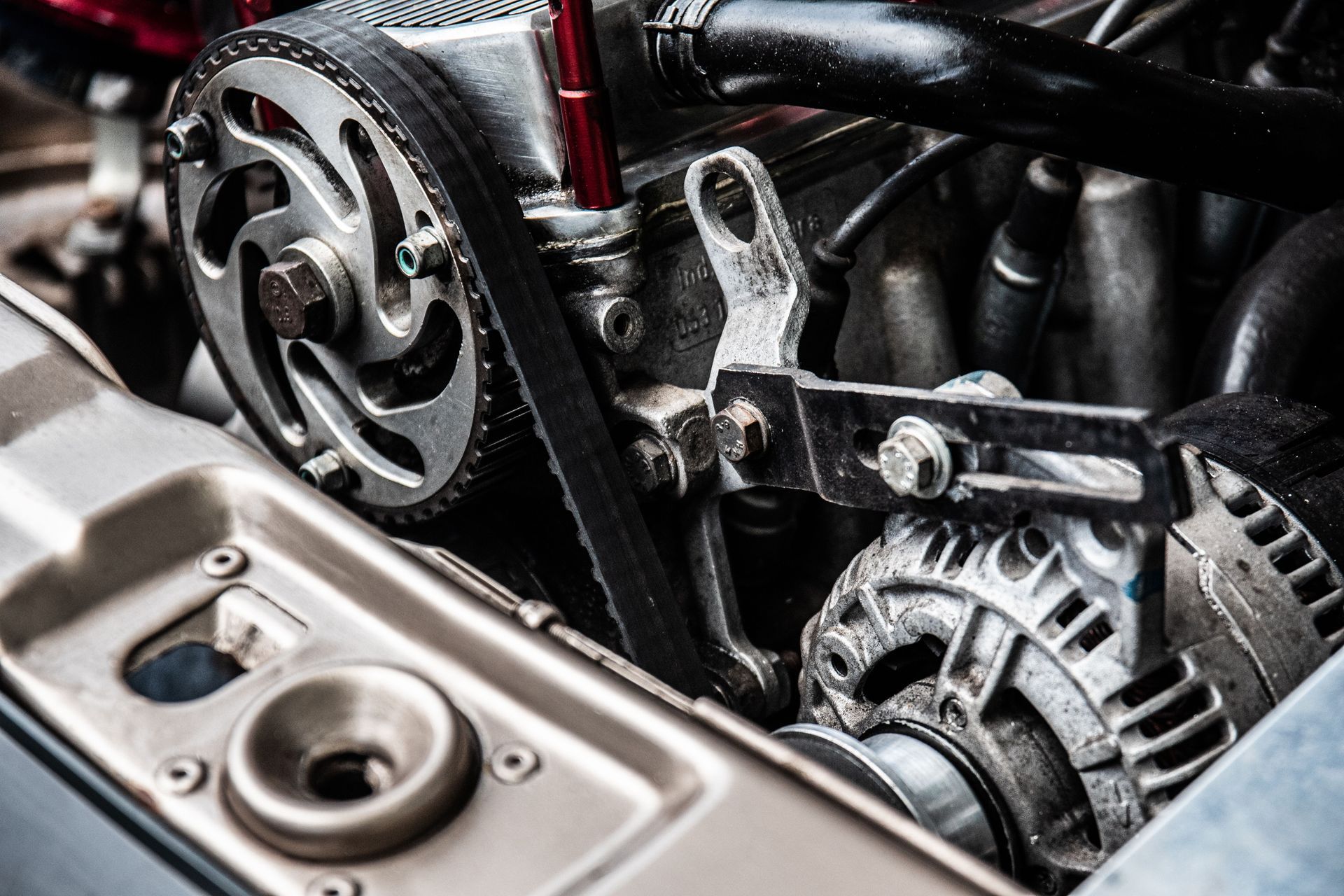
The timing belt keeps the top of your engine and the bottom of your engine turning in the correct relationship to each other. Valves open and close at precise moments relative to the pistons, and the belt is what enforces that timing.
When a belt breaks, that relationship ends instantly. The engine stops immediately, wherever you happen to be.
What happens next depends on your engine's design. In some engines, the valves and pistons cannot occupy the same space, and a broken belt means the engine stops and stays stopped until the belt is replaced. In others, the design allows contact, and a broken belt can cause internal damage that turns a belt job into engine repair.
Which category your vehicle falls into depends on the engine, and it is worth finding out. That single fact changes how much risk you are carrying.
You Will Not Get a Warning
This is the part that catches people. Brakes squeal. Tires wear visibly. A failing alternator usually flickers something on the dash first.
A timing belt gives you none of that. It is behind a cover, it is not visible during a normal inspection, and it does not announce itself before it goes. There is no symptom to watch for and no test that tells you how many miles are left in it.
That absence of warning is precisely why the manufacturer publishes an interval instead. The interval exists because inspection cannot substitute for it.
How to Find Out Where You Stand
Three steps, and none of them cost anything.
- Check your owner's manual for a timing belt entry. Intervals vary a great deal between manufacturers and engines, so use the number for your vehicle rather than one you heard somewhere.
- Look through your service records to see whether it has already been done. On a used car, this is the single most valuable thing you can find in a folder of receipts.
- If there is no record and no way to know, tell us. An unknown history on a vehicle old enough to be due is worth treating as due.
If the records are missing entirely, that is common, especially on a car bought secondhand. It is a solvable problem, not a dead end.
Doing It Once Instead of Twice
The belt itself is not what makes this job significant. The labor is. Getting to the belt means removing a fair amount of what sits in front of it.
That is why several components are commonly replaced at the same time. The water pump, tensioner, idler pulleys, and related seals often sit in the same area, and reaching them again later means paying that same labor a second time.
Whether that makes sense for your vehicle is a conversation, not a default. We will lay out what is recommended together, what the reasoning is, and what it looks like if you do the belt alone. You see the findings in a digital inspection report and you make the call.
Parts can be the same OEM parts the dealership uses or reconditioned parts, depending on what fits your situation. Financing options are available if the timing is difficult. The work carries our 3-year/36,000-mile warranty on parts and labor.
The Case for Planning It
A planned repair is a repair you choose the date for. You can set money aside, pick a week that works, arrange a loaner car or an Uber ride, and drop the car after hours using our secure lock boxes.
An unplanned one is a tow, an unknown, and whatever the calendar happens to look like that day. That is the real difference, and it is the whole argument for preventive maintenance in one sentence.
Ask Us About Your Timing Belt
If you are not sure whether your vehicle has a belt or a chain, or whether yours is due, call and ask. Call 513-427-5000 to schedule timing belt service or just to get an answer. We are located at 5591 Wooster Pike, Cincinnati, OH 45227, and every repair is backed by our 3-year/36,000-mile warranty on parts and labor.